
Energy work
Qigong, Integrated Into Every Class
Qigong, meaning “energy work,” is a centuries-old practice for cultivating body awareness, breath control, and internal strength.
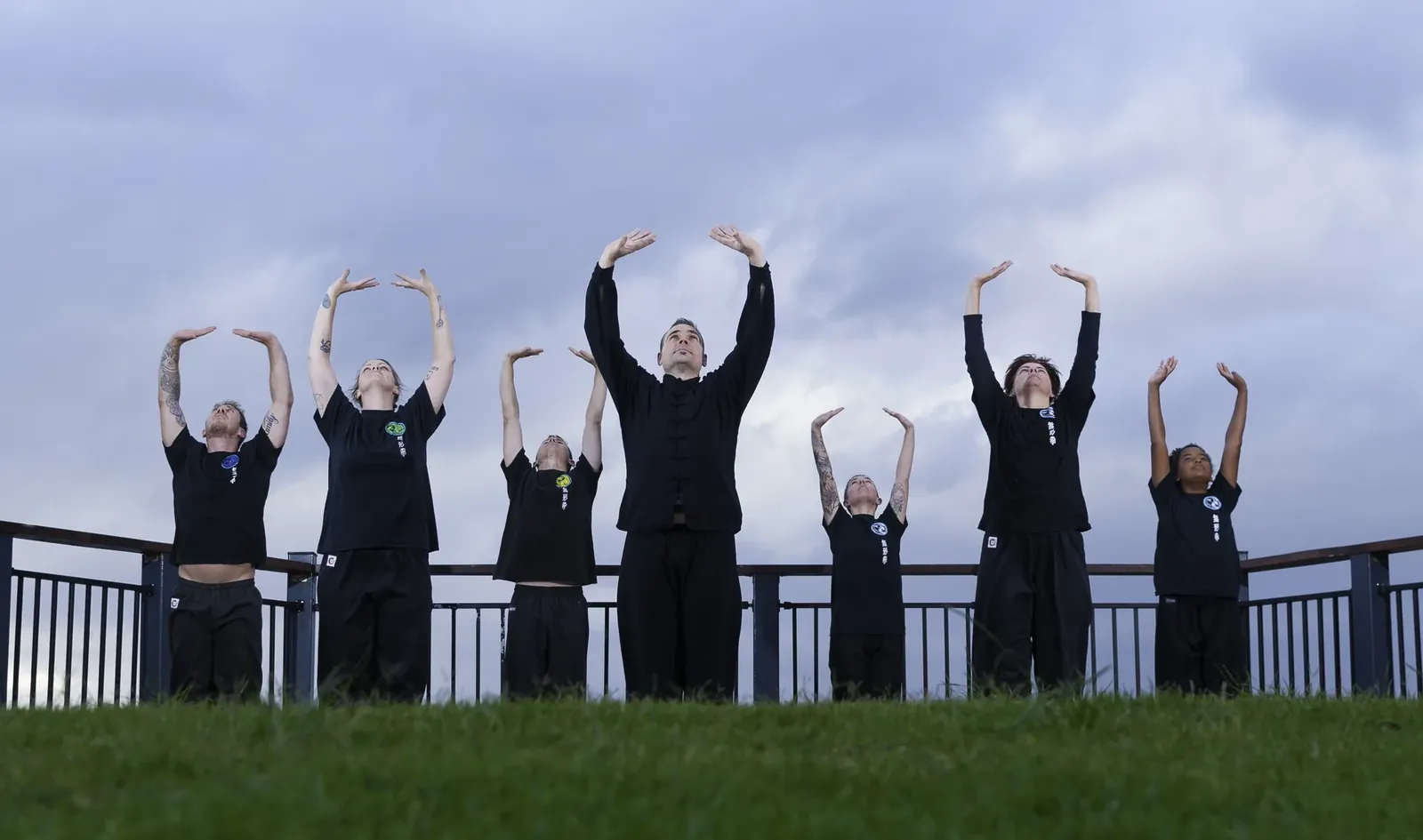
At Wu Xing Dao, Qigong isn’t a separate class, it’s woven directly into our Kung Fu curriculum. Every session includes Qigong training as part of how we build internal power, flexibility, and long-term health. Whether you’re training in Baguazhang, Xing Yi, or any of our internal styles, you’re training Qigong at the same time.
Looking for a dedicated Qigong or Tai Chi program without the martial arts training? See our upcoming online offering below.
Common questions
Qigong, answered
Is Qigong the same as Tai Chi?
Although Tai Chi and Qigong are both internal training methodologies, and both can greatly improve your health and fitness, they are not the same thing.
Traditional Tai Chi was first and foremost a martial arts practice, used for self-defence and fighting strategies, well before it became popularised as a gentle movement practice for health and wellbeing.
They both share the concept of generating internal energy, and feeling your Qi move throughout your body during practice; however, Tai Chi’s original intent of cultivating this energy was to quickly end a violent confrontation, using the assailants’ aggression and physicality against them, redirecting their force using a minimum of effort.
What is Qigong good for?
Qigong has a huge array of benefits, from enhancing your awareness of internal energy to calming your mind and allowing you to stay focused for long periods of time, even when you are really busy.
From a physical perspective, Qigong will also help lower blood pressure, ease muscular tension, improve blood and oxygen circulation, teach you how to coordinate breathing whilst moving and increase your daily energy levels.
Which is better: Yoga or Qigong?
Yoga and Qigong share a lot of similarities at their core; both are ancient training systems that were designed to improve health through breathing, movement and meditation. When delving deeper into each art, they are also both spiritual practices, which when trained consistently and become a part of your daily life, are designed to help you reach a level of spiritual enlightenment.
The only thing I would suggest when researching and deciding on whether to pursue Qigong or Yoga is trying to ascertain the experience level of the practitioner you plan to learn from, and also what you hope to achieve as an outcome from your training.
Yoga has become a very popular practice in Australia, and with the rise in popularity, you will also find many instructors who may not have a full understanding of all of the techniques available in Yoga practice. There are also many different variations of Yoga practice, some of which focus more on meditation to open the Chakras of the body for spiritual enlightenment, and others which focus more on the physical aspects, such as stretching the muscles, tendons and fascia for a greater range of movement.
Can you learn Qigong by yourself?
Whilst it is possible to watch some tutorial videos online or enrol in digital courses that can teach aspects of Qigong for beginners, it is also helpful to receive real-time feedback on technique, to deepen your awareness of internal energy cultivation.
When I think of other businesses that teach Qigong near me, I feel that Wu Xing Dao differentiates itself from the ‘competition’ as we offer both digital courses to introduce the concepts of Qigong practice and to share some of the theoretical knowledge of the training, as well as in-person training to enhance your knowledge and ensure you are learning the techniques correctly.
We feel that this combined approach offers our students the best of both worlds, as we all learn and understand content differently, and some people benefit from more in-depth theory and being able to understand the meridian networks and acupressure points often referred to in Qigong training, and others prefer to train the physical aspects and ‘feel’ the energy moving as they train.
Can Qigong be harmful?
I often see a lot of blogs online that comment that training Qigong without proper instruction can be harmful, as without understanding the fundamental concepts of growing, storing and moving energy, it can result in an excess of energy accumulation, or blockages in energy flow that can result in poor health or ailments affecting internal organs.
In my experience though, I have been training Qigong for many years now, and have not experienced any ill health effects from training. The only negative side effect I have experienced when first starting my practice is that if I practice Qigong too late in the day, sometimes I have trouble sleeping, as the energy accumulation is so strong, that I feel I am wide awake, sometimes even after a really busy day. That is a good problem to have though, and often I can counteract the effects of an overabundance of energy by following a process of breathing down prior to bedtime, I find I fall asleep quite easily.
How often should you practice Qigong?
I find that the more you practice Qigong, the more quickly you notice the benefits, however, it all depends on your daily routine, and how much time you can put aside for your practice. Some of the Qigong methods we teach can be completed in as little as 15 – 30 minutes per day; however, there are some longer Qigong routines that can take an hour or more, again based on your preferences.
I think that starting with two to three sessions per week is a great start, and gradually building up your time spent practising as you start to see the benefits. I have no doubt that you will start to become addicted as I did, to the fantastic sensation of calmness and peace you experience while training, and the great increase in energy you will have throughout the day.
Can you overdo Qigong?
With the busy lifestyle we all have in this day and age, I find it hard to believe anyone would have enough time to practice Qigong to the extent that they ‘overdo’ their training. Having said that, opinion is all relative, and if you find that putting time aside for practice interferes with other important activities such as spending time with family, or completing work or other important daily tasks, and this ends up causing you stress, or you find it hard to ‘fit everything in’, then obviously it would be my advice to dial it back a bit.
Qigong practice is all about enhancing your health and wellbeing, and causing yourself stress by trying to fit training in every day goes against everything that Qigong is designed to help with, so take your time and build up your training slowly.
What time should I practise Qigong?
This is again a question that causes a lot of contention, mixed opinions and misinformation, and sometimes causes people to shy away from giving Qigong a go. Long story short there is a Qigong ‘training clock’, which shows the best times of day to work on specific organs within the body, to maximise the training benefit.
With that in mind though, if I told you to get up from 1:00 am – 3:00 am to train your liver or to stop working from 9:00 – 11:00 am so that you could practice Qigong for your Spleen, it just wouldn’t be a realistic expectation, and would only set you up for failure.
My belief is in trying to find a time of day during the week that you can ‘pencil in’ to your diary as a set time for practice, and stick to these times consistently, you will have created a habit that can be reasonably expected to work with your lifestyle. There will always be exceptional circumstances that require you to switch to an alternative time or day for practice, but having a schedule will at least mean you have a program you can stick to. Even more important is that you can advise your family and friends that this is your designated time for training, and so switching off your phone and taking the time out to improve yourself will be a guilt-free experience, as everyone will know that this is not the best time to ‘bother you’ with something unless it is super important.
How do I start practising Qigong?
The best way to get started is to first decide how you like to learn. If you are someone who likes a lot of information and theory in order to fully understand the ‘why’ as well as the ‘how’ of practice, then one of our online courses would be a great start. If you prefer real-time feedback and correction on exercises and don’t mind having less theory discussed during training, then our in-person class is a great way to go.
Ultimately a combination of in-person and online theory would be the best way to fully understand the depth of the practice that is Qigong, as there is a tonne of information, as well as variation in training principles and practice.
Coming soon
Online Qigong and Tai Chi, Coming Soon
For those who want the health, mobility, and stress-relief benefits of Qigong and Tai Chi without the martial arts side of our curriculum, we’re building a dedicated online program: gentle, low-impact, and accessible from anywhere.
Perfect for older adults, anyone managing mobility or joint concerns, or simply looking for a calmer, more restorative practice.
Unit 1/4 Brooks Avenue, Wyoming, NSW 2250